The ETENWOLF Pencil Tire Pressure Gauge 2 Pack (10-50PSI review is aimed at drivers who want straightforward manual checks across more than one type of vehicle.
Its two gauges cover different ranges, with a metal build, individual storage cases, and spare valve caps rounding out the kit.
ETENWOLF Pencil Gauge Review Summary
The quick verdict
6,000+ ratings
Read Amazon ReviewsETENWOLF Pencil Tire Pressure Gauge 2 Pack
A practical fit for drivers who want two compact analog gauges covering everyday car pressures and broader ranges for RVs, pickups, and bicycles.
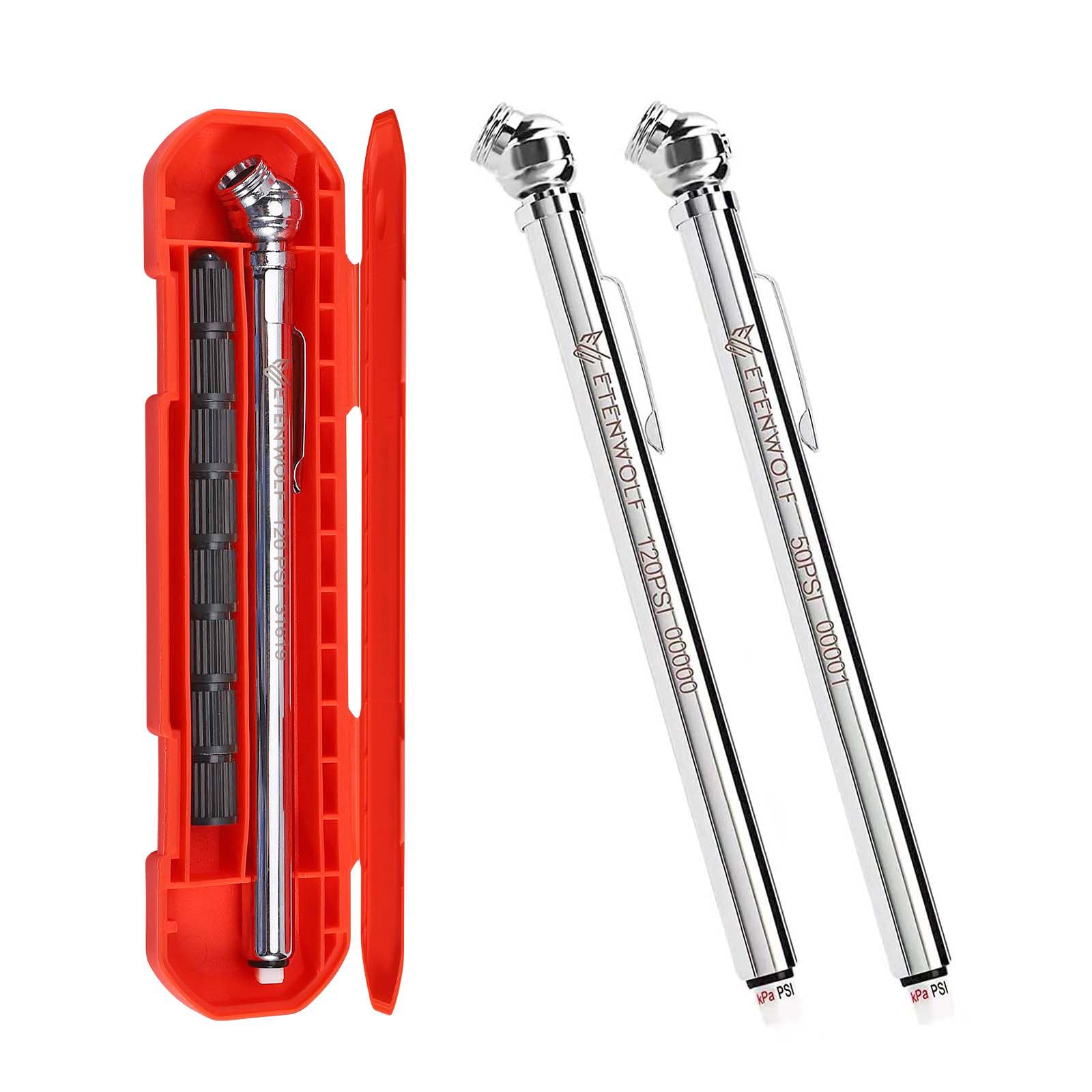
- Includes two pencil tire pressure gauges: one with a 10–50 PSI range and one with a 20–120 PSI range.
- Manual calibration to ANSI B40.1 Grade B: accuracy is specified as 2% of span in the middle 50% of the range and 3% of span in the lower and upper 25%.
- All-metal construction with stainless steel bodies and zinc alloy heads.
- Each gauge has a unique calibration number printed on its body.

Pros
- Two distinct measurement ranges make the set useful across more vehicle types than a single-range pencil gauge.
- The stated calibration standard and range-specific tolerance give buyers concrete accuracy information to consider.
Consider before buying
- The gauges do not share the same scale: select the 20–120 PSI model when a reading may exceed 50 PSI.
- The described accuracy is less tight near the lower and upper quarters of each range than in the middle half.
Read the full review summary
The appeal is in the range split: one pencil gauge covers 10–50 PSI, while the second reads 20–120 PSI.
That gives a buyer a tool for routine car tires and another with more headroom for vehicles or equipment that call for higher readings, while keeping both gauges mechanical and compact.
This kit suits drivers who prefer a simple, battery-free format and want a gauge to keep in more than one vehicle or location.
The stainless steel bodies and zinc alloy heads are designed for durability, and each gauge is manually calibrated to an ANSI B40.1 Grade B tolerance.
The main tradeoff is that each gauge has its own range, so choosing the correct one matters; the narrow-range model is not the right pick for readings above its limit.
The buying factors
ETENWOLF Pencil Gauge Scorecard
Editorial scores reflect listed features and buyer fit; they are not laboratory measurements or customer ratings.
Range coverage
Two separate scales cover 10–50 PSI and 20–120 PSI, accommodating a broader mix of tires than a single narrow-range gauge.
Calibration detail
The product specifies manual calibration to ANSI B40.1 Grade B, with accuracy tolerances that vary by position within each range.
Build materials
The all-metal construction combines stainless steel bodies with zinc alloy heads.
Portability
Pencil-style gauges are compact in form, and the kit includes a separate storage case for each.
Everyday versatility
The different pressure ranges and included valve caps support a range of common vehicle tire-checking routines.
Reading convenience
The mechanical pencil format avoids a display or batteries, though buyers who prefer a large illuminated dial may want another style.
Pressure adjustment
The description notes that the gauge can deflate tires above 16 PSI, offering some adjustment utility while attached to a tire.
Key Features and Specifications of ETENWOLF Pencil Gauge
- Includes two pencil tire pressure gauges: one with a 10–50 PSI range and one with a 20–120 PSI range.
- Manual calibration to ANSI B40.1 Grade B: accuracy is specified as 2% of span in the middle 50% of the range and 3% of span in the lower and upper 25%.
- All-metal construction with stainless steel bodies and zinc alloy heads.
- Each gauge has a unique calibration number printed on its body.
- Can be used to deflate tires when pressure is above 16 PSI.
- Includes two storage cases and 16 valve stem caps.
Pros and Cons of ETENWOLF Pencil Gauge
Pros
- Two distinct measurement ranges make the set useful across more vehicle types than a single-range pencil gauge.
- The stated calibration standard and range-specific tolerance give buyers concrete accuracy information to consider.
- Metal bodies and heads are designed for repeated use.
- Separate cases help keep the gauges together with vehicle gear, while the extra caps provide convenient spares.
Consider before buying
- The gauges do not share the same scale: select the 20–120 PSI model when a reading may exceed 50 PSI.
- The described accuracy is less tight near the lower and upper quarters of each range than in the middle half.
- A pencil gauge may be less convenient for buyers who want a large dial or an illuminated digital reading, especially in dim conditions.
Who Should Buy ETENWOLF Pencil Gauge?
Good fit
Consider the ETENWOLF Pencil Gauge set if you want a simple analog tool for checking tires on multiple vehicles.
The 10–50 PSI gauge is suited to readings in its range, and the 20–120 PSI gauge offers a higher ceiling for tires that need it.
Before each check, match the gauge to the expected pressure and stay within its marked range.
The kit also makes sense for a garage or household where gauges may be kept in separate vehicles. Each one comes with its own case, and 16 valve caps add a useful supply of replacements.
The stated calibration tolerances let careful buyers understand that accuracy varies across a gauge’s scale rather than being one uniform percentage at every reading.
Choose this format if you value a mechanical tool with a metal body and do not need a digital screen.
Its ability to release air above 16 PSI can help when pressure is higher than desired, though buyers should follow their vehicle’s recommended tire pressure and make small adjustments.
Who should skip it
Skip this set if you need a single gauge with one easy-to-read illuminated display or prefer a digital readout. A dial-style or digital model may be a better fit for those priorities.
It is also a poor match if you want one gauge to cover every pressure: the lower-range model tops out at 50 PSI, so use the higher-range gauge when appropriate and confirm its range meets your needs.
How the ETENWOLF Pencil Gauge fits a vehicle toolkit
Choosing between the two ranges
The two scales are a practical distinction, not interchangeable versions of the same gauge. Use the 10–50 PSI model when the expected reading is within that band; the 20–120 PSI model reaches substantially higher.
If you routinely check different vehicles, keeping both cases accessible can make it easier to select the suitable tool without relying on a single gauge’s limit.
What the calibration tolerance means
The stated ANSI B40.1 Grade B calibration provides a useful accuracy reference, but the tolerance is tied to span and varies across the scale.
The specification is 2% of span in the middle half and 3% in the outer quarters.
For a buyer, this means the reading location on the scale matters when judging the stated precision; the unique calibration number on each gauge also distinguishes its individual calibration.
A manual tool with a durable material choice
The stainless steel body and zinc alloy head give the gauges an all-metal construction, a sensible choice for equipment that may be handled repeatedly and stored in a vehicle. Two dedicated cases help protect and organize the pair.
The pencil format is compact and straightforward, though its scale-reading experience may not suit people who favor larger displays.
Using the deflation feature
The description says the gauges can release air when tire pressure is above 16 PSI.
That adds a basic adjustment function to pressure checking, but a buyer should still use the correct gauge range and compare the reading with the vehicle’s recommended pressure.
The 16 PSI condition is worth keeping in mind when considering whether the feature matches a particular tire-check routine.
Alternatives to ETENWOLF Pencil Gauge
Analog Tire Pressure Gauges alternative
9,000+ ratings
Read Amazon ReviewsETENWOLF T300 Digital Tire Pressure Gauge
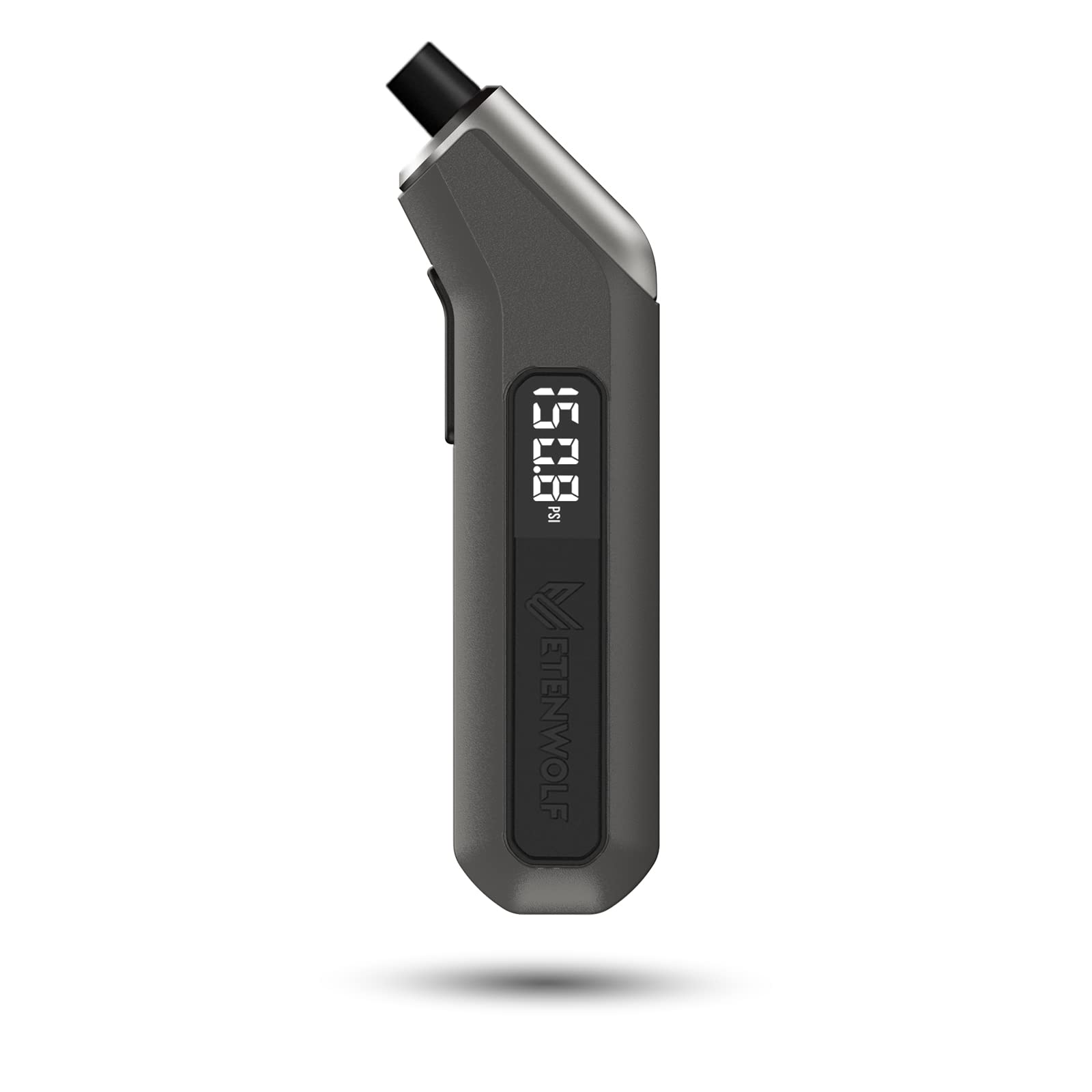
Choose the T300 if you prefer a digital readout, need a broader single-gauge range, or want the built-in lighting. The Pencil Gauge set is a better fit if you prefer mechanical tools and value having two separate gauges.
- The T300 is a digital gauge with a 3–200 PSI range, a backlit LED screen, replaceable AAA batteries, and an LED light for dark areas.
- Its stated calibration is ANSI B40.7 Grade 2A, and a Presta valve adapter is not included.
- The Pencil Gauge set offers two mechanical scales, 10–50 PSI and 20–120 PSI, and includes two separate cases.
Analog Tire Pressure Gauges alternative
2,000+ ratings
Read Amazon ReviewsETENWOLF 0–75 PSI Glow Dial Tire Pressure Gauge
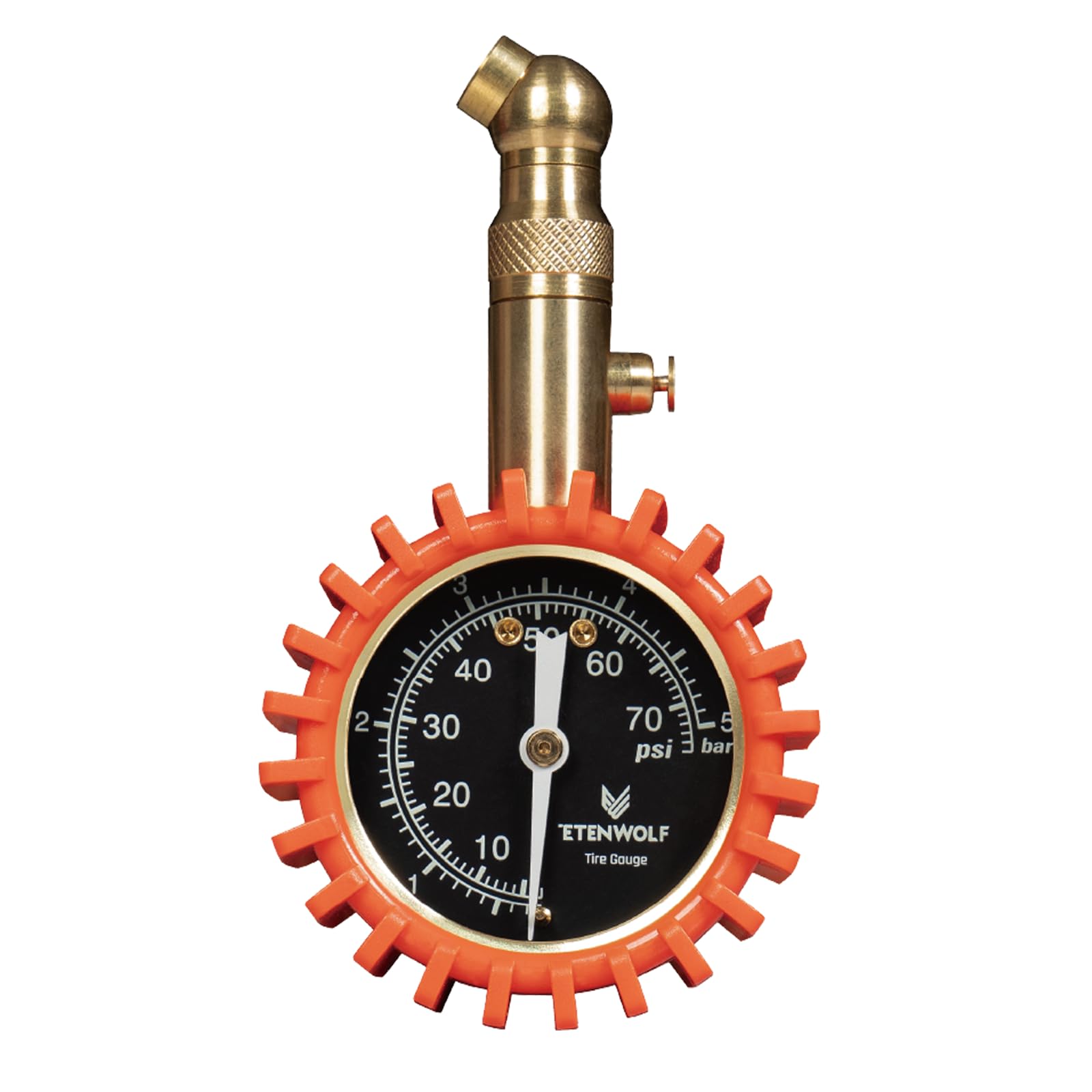
Consider the glow-dial model if you want one analog gauge with a larger dial, swivel access, and a 0–75 PSI scale.
The Pencil Gauge set is more suitable when separate gauges in distinct ranges and the 120 PSI upper range are more useful to you.
- This analog model covers 0–75 PSI and features a large glow dial, a 360-degree swivel chuck, manual ANSI B40.1 Grade A calibration, and a storage bag.
- The Pencil Gauge set divides its coverage between two compact analog gauges, with the higher-range model reaching 120 PSI.
Is ETENWOLF Pencil Gauge Worth It?
The ETENWOLF Pencil Tire Pressure Gauge 2 Pack is worth considering for drivers who want two simple, metal-bodied gauges that cover different pressure bands.
Its range split, individual cases, spare caps, and stated calibration details make the kit practical for a mixed-vehicle garage or as a pair of vehicle tools.
Buy it if you are comfortable reading a pencil-style analog scale and will select the gauge that matches the tire’s expected pressure.
Look elsewhere if a large illuminated or digital display is central to your routine, or if one gauge must cover a range outside the included models’ limits.
Your review at a glance
6,000+ ratings
Read Amazon ReviewsETENWOLF Pencil Tire Pressure Gauge 2 Pack
A practical fit for drivers who want two compact analog gauges covering everyday car pressures and broader ranges for RVs, pickups, and bicycles.
- Includes two pencil tire pressure gauges: one with a 10–50 PSI range and one with a 20–120 PSI range.
- Manual calibration to ANSI B40.1 Grade B: accuracy is specified as 2% of span in the middle 50% of the range and 3% of span in the lower and upper 25%.
- All-metal construction with stainless steel bodies and zinc alloy heads.
- Each gauge has a unique calibration number printed on its body.