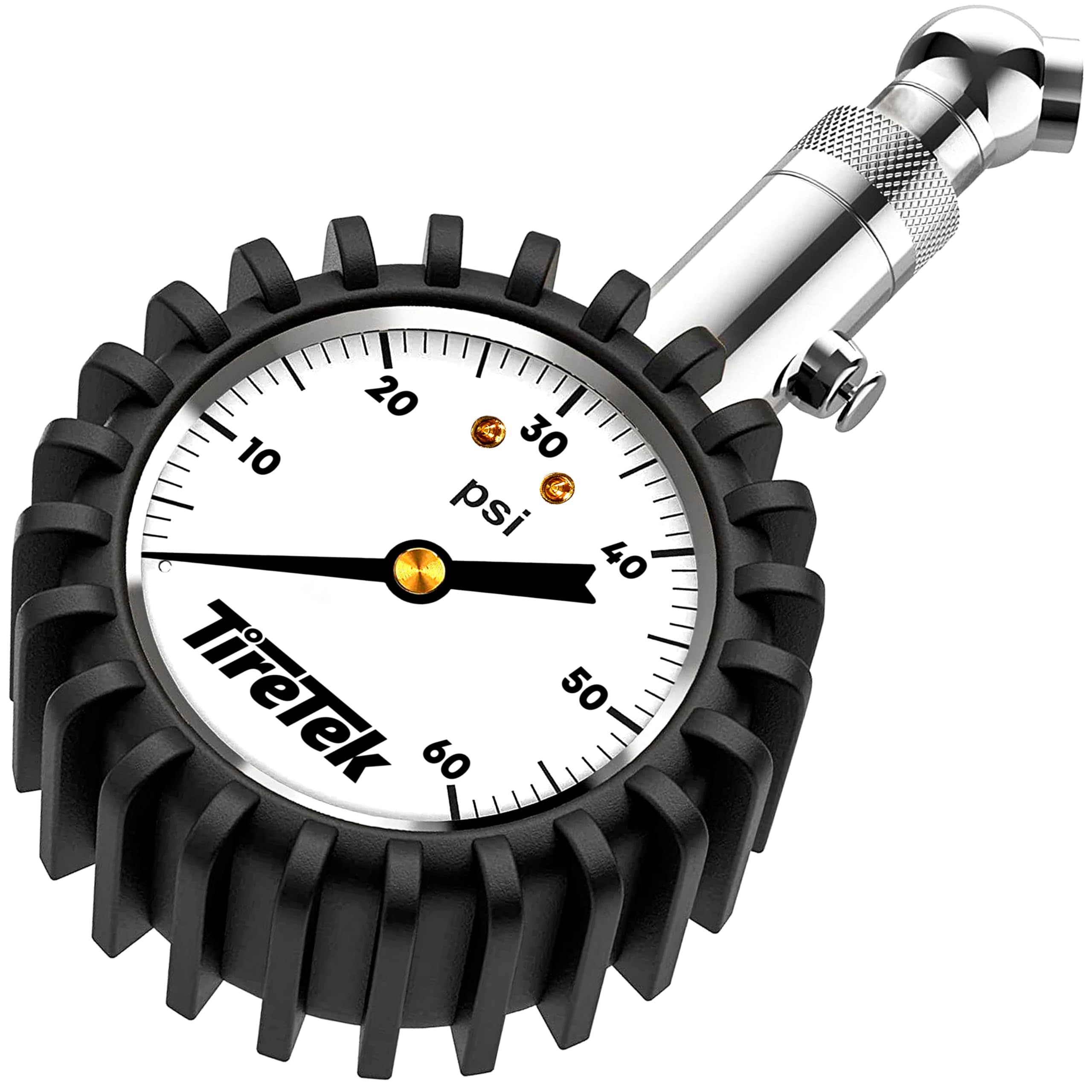
The Tire Pressure Gauge for Cars is a battery-free analog tool for drivers who want a straightforward way to check and adjust tire pressure during routine maintenance.
This Tire Pressure Gauge for Cars review looks at its pressure range, dial design, and handling features to help you decide whether it suits your garage kit.
Car Tire Gauge Review Summary
The quick verdict
9,000+ ratings
Read Amazon ReviewsTire Pressure Gauge for Cars
A fit for drivers who want a battery-free analog tire gauge with a swivel chuck and an on-gauge air-release button.
- Analog dial measures tire pressure up to 60 PSI.
- Described as calibrated to ANSI B40.1 Grade B, with 2% accuracy.
- Steel and brass construction with a rubber cover for grip and impact protection.
- Extended 5 mm chuck tip and a 45-degree angled chuck that swivels.

Pros
- Battery-free mechanical design avoids power management.
- On-valve relief button supports fine pressure adjustments without disconnecting between small releases.
Consider before buying
- The 60 PSI maximum may not suit tires that require pressure readings above that range.
- A dial requires a clear view of the face while taking a reading; buyers who prefer a numeric screen may want another format.
Read the full review summary
This gauge brings together a 60 PSI analog dial, steel and brass construction, a rubber outer cover, and a swiveling chuck angled at 45 degrees.
Its built-in relief valve lets you release air while the gauge remains attached, which can make small adjustments more controlled than repeatedly removing and reconnecting the tool.
The description gives an ANSI B40.1 Grade B accuracy classification of 2%, a useful point of reference for buyers comparing manual gauges.
It is aimed at drivers who prefer a mechanical reading and do not want to manage batteries.
The stated vehicle fit includes cars, motorcycles, trucks, bikes, SUVs, RVs, and ATVs, though buyers should check their tire pressures against the 60 PSI maximum and confirm that the chuck geometry suits their valve access.
Its features favor uncomplicated checks and incremental deflation over digital readouts or extended reach.
The buying factors
Car Tire Gauge Scorecard
Editorial scores reflect listed features and buyer fit; they are not laboratory measurements or customer ratings.
Everyday pressure range
The 60 PSI maximum covers many ordinary vehicle checks, but buyers with higher-pressure needs should confirm their requirements first.
Reading confidence
The gauge is described as calibrated to ANSI B40.1 Grade B with 2% accuracy, giving buyers a stated calibration benchmark.
Dial readability
The dial is described as easy to read and glow in the dark, which may help in dim settings; the exact dial size is not provided.
Valve access
A 45-degree chuck that swivels can help with positioning around different valve angles.
Pressure adjustment
The relief button allows air to be released while the gauge stays on the valve, supporting incremental adjustment.
Power simplicity
Mechanical operation requires no batteries, keeping the tool ready without a power source.
Key Features and Specifications of Car Tire Gauge
- Analog dial measures tire pressure up to 60 PSI.
- Described as calibrated to ANSI B40.1 Grade B, with 2% accuracy.
- Steel and brass construction with a rubber cover for grip and impact protection.
- Extended 5 mm chuck tip and a 45-degree angled chuck that swivels.
- Built-in relief valve releases air while the gauge is still attached to the tire valve.
- Mechanical operation requires no batteries; the dial is described as glow in the dark.
- Intended for cars, motorcycles, trucks, bikes, SUVs, RVs, and ATVs.
Pros and Cons of Car Tire Gauge
Pros
- Battery-free mechanical design avoids power management.
- On-valve relief button supports fine pressure adjustments without disconnecting between small releases.
- Swiveling angled chuck offers flexibility when positioning at the valve.
- Rubber cover provides a grippable outer surface and a layer of protection.
Consider before buying
- The 60 PSI maximum may not suit tires that require pressure readings above that range.
- A dial requires a clear view of the face while taking a reading; buyers who prefer a numeric screen may want another format.
- The description does not specify the dial diameter, so consider whether the face size will be comfortable for your eyesight and working position.
Who Should Buy Car Tire Gauge?
Good fit
Consider this gauge if your routine involves checking common passenger-vehicle pressures and you value a manual tool that is ready without batteries.
The stated calibration classification, covered body, and swiveling chuck make it a practical candidate for a glove box or home garage kit, provided the 60 PSI ceiling fits the vehicles you maintain.
The relief valve is useful for drivers who want to bring an overinflated tire down in small steps.
Keep the gauge attached, press the bleed button briefly, and recheck the dial as needed; follow the vehicle or tire maker’s recommended pressure when setting the target.
Who should skip it
Choose a different range if your tires may require readings above 60 PSI. Check the pressure requirement on the vehicle placard or tire guidance before relying on this gauge for a particular vehicle.
If you need a backlit numeric display, prefer a digital format. The gauge described here uses an analog dial, even though its face is intended to glow in the dark.
How the Car Tire Gauge Fits Everyday Checks
A 60 PSI range for routine use
The upper limit is a key fit check. It is broad enough for many everyday car pressure checks, while the stated compatibility list also includes larger vehicle types and recreational vehicles.
Since actual tire requirements vary, compare your vehicle’s recommended pressures with the gauge’s range before choosing it.
A reading at the edge of a gauge’s scale can also be harder to interpret precisely, so a higher-range tool may be preferable if your routine regularly involves pressures near or above the limit.
Manual calibration and interpretation
The ANSI B40.1 Grade B classification and 2% accuracy figure provide a specific calibration reference, but the dial still needs to be read carefully.
Align the gauge squarely with the valve, hold it steady, and make sure the chuck seals before relying on the result.
The extended tip is intended to help make that connection, while the swiveling joint gives some freedom to position the head. For consistent checks, use the same method and compare all tires under similar conditions.
An adjustment feature that stays connected
The relief valve is a practical addition because checking and bleeding can happen at the valve without removing the gauge between actions. That makes short releases easier to manage when pressure is above the target.
Pressing the button briefly and checking again gives you a chance to avoid releasing too much air at once.
The tool is a gauge, however, so buyers who also need to add air will still need a separate inflation source.
Handling and visibility
Steel and brass components, a rubber cover, and a no-battery design point to a simple tool that can live in a vehicle or workshop.
The cover may improve grip and help shield the body from everyday knocks, while the glow-in-the-dark dial is intended to help with low-light checks. The 45-degree swiveling chuck can ease access when a valve is awkwardly positioned.
If you often work in tight wheel wells, consider whether the gauge’s overall shape and dial placement provide enough room to hold and read it comfortably.
Alternatives to Car Tire Gauge
Analog Tire Pressure Gauges alternative
2,000+ ratings
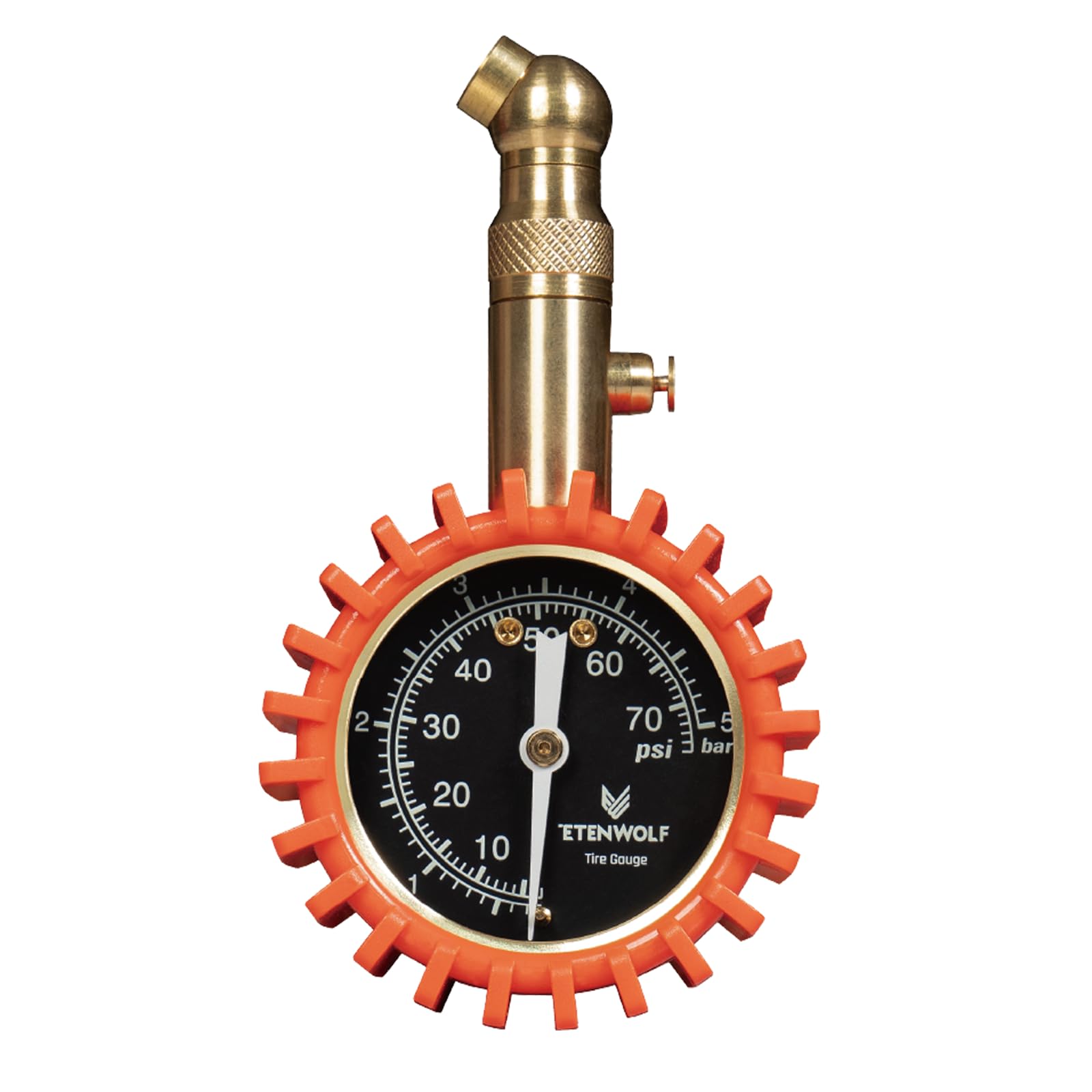
Read Amazon ReviewsETENWOLF 0–75 PSI Glow Dial Tire Gauge
Consider the ETENWOLF if you want a higher pressure ceiling, a full swivel, or the more precise stated calibration class.
The main gauge remains a reasonable option if 60 PSI is sufficient and its relief valve and battery-free mechanical operation are the features you value.
- The ETENWOLF gauge has a 0–75 PSI range, a large glow dial, a 360-degree swivel chuck, and is calibrated to ANSI B40.1 Grade A with ±1% of span.
- Its stated accessories include a storage bag, valve caps, and valve cores.
- The Tire Pressure Gauge for Cars has a 60 PSI maximum, a 45-degree swiveling chuck, and an on-gauge relief valve.
Analog Tire Pressure Gauges alternative
5,000+ ratings
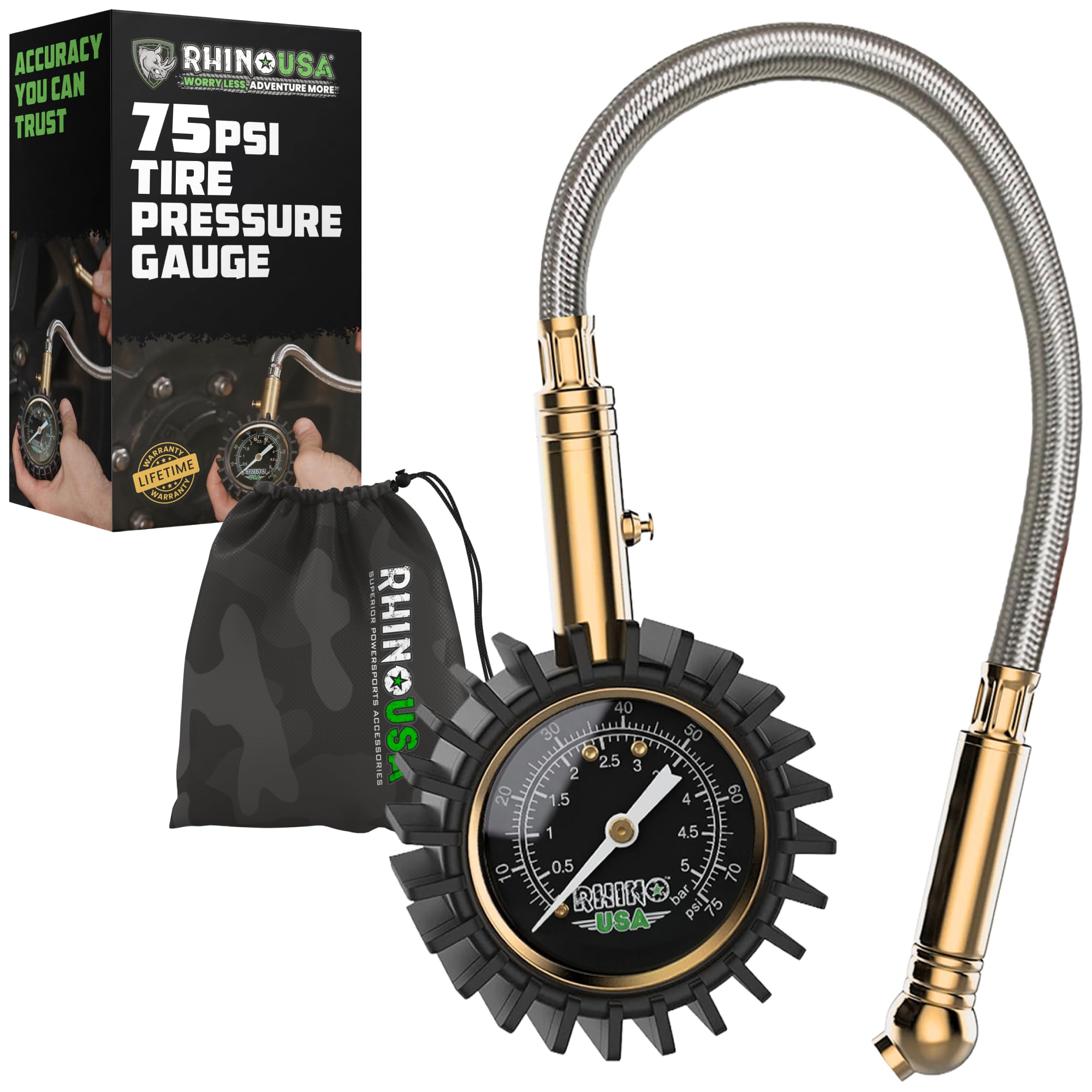
Read Amazon ReviewsRhino USA Heavy Duty Tire Pressure Gauge
The Rhino USA option may suit buyers who prioritize a larger dial and a flexible hose for reaching difficult valve stems.
Choose the main gauge when a more compact, direct-to-valve arrangement and its on-gauge relief feature fit your routine.
- The Rhino USA gauge measures up to 75 PSI and uses a 2-inch glow dial, braided hose, solid brass hardware, and a 360-degree swivel.
- Its description also mentions a lifetime warranty.
- The Tire Pressure Gauge for Cars uses a compact chuck design with a glow dial, a rubber cover, and a relief valve.
Is Car Tire Gauge Worth It?
The Tire Pressure Gauge for Cars is worth considering for drivers who want a straightforward mechanical gauge, no batteries, and a way to bleed excess air while checking pressure.
Its stated 2% accuracy classification and swiveling chuck add useful detail to an otherwise simple design.
Before buying, verify that your tire pressures fit within the 60 PSI range and that an analog dial matches your preference.
If those conditions fit, it offers a practical combination of routine measurement, low-light dial visibility, and on-valve adjustment.
Your review at a glance
9,000+ ratings
Read Amazon ReviewsTire Pressure Gauge for Cars
A fit for drivers who want a battery-free analog tire gauge with a swivel chuck and an on-gauge air-release button.
- Analog dial measures tire pressure up to 60 PSI.
- Described as calibrated to ANSI B40.1 Grade B, with 2% accuracy.
- Steel and brass construction with a rubber cover for grip and impact protection.
- Extended 5 mm chuck tip and a 45-degree angled chuck that swivels.